There’s a lot more to cranberries than the can-shaped sauce served at Thanksgiving.
As a kid, I never liked cranberries—I wasn’t even sure what they were to be perfectly honest. My only exposure to anything containing cranberries was the jellied “sauce” that plopped out of a can at Thanksgiving. It tasted sour to me, and I couldn’t understand why anyone ate it.
We usually don’t think much about cranberries except during the holiday season, when fresh cranberries reappear in the grocery store. Who grows cranberries? How do they grow? On a tree? A bush? The answer may surprise you.
Cranberries are native to North America, making them a true “American” fruit. Native Americans ate cranberries along with other berries. Back in the 1600’s, English colonists found cranberries growing wild in what is now Southern Canada and the Northeastern U.S.
You may have seen the claim that cranberries are one of only three fruits native to North America—the other two being grapes and blueberries. Like so many internet “facts,” there is a grain of truth in this statement, but it’s not quite accurate.
- North America is the origin of a long list of fruits. Some sources clarify that cranberries, grapes, and blueberries are the only native North American fruits grown commercially and recognized globally. While that’s a better statement, it’s still not the whole story.
- Fragaria virginiana, a species of wild strawberry used to develop modern day strawberries is native to North America, as is the squash genus Cucurbita.
- If we include Central America as part of North America, then tomatoes are native to North America too. These are all crops grown commercially and recognized globally.
Cranberries may not be the rarity that some statistics claim, but they still are a unique fruit.
As a young girl, I remember learning in school that cranberries grew in bogs. For longer than I care to admit I pictured cranberries on a bush, growing in a swampy bog, bobbing along, waiting for Thanksgiving.
I was stunned and fascinated when I learned cranberries grow on creeping evergreen shrubs that are only about eight inches tall at best.
Cranberry stems arise from an underground rhizome; leaves are exceedingly tiny, at only ¼” to ½” long. Individual leaves live for two years.
Cranberry plants produce flowers in late June and early July singly at the end of each upright stem. The whitish-pink flowers hang downward– the flowers reminded European settlers in the New World of the head of a crane, so they called the fruits craneberries, which later evolved to cranberry.
Cranberries prefer acidic, sandy soil with added organic matter. Often peat moss is used as the source of organic matter. The idea of a “cranberry bog” is not because farmers use peat moss, but is rooted in the methods used to harvest the fruit and provide winter protection for the plants.
Water is crucial to commercial cranberry growing and harvesting
For every acre of cranberries grown, growers need three to ten acres of “support” land for water storage or transport. Cranberry plants are very flood tolerant, but also very sensitive to drying out in cold winter winds.
Flooding cranberry fields protects the plants, but also the next year’s crop. The next year’s flower buds form near the end of the current growing season. If plants die over the winter, the flower buds die too. Since each flower develops into a cranberry, loss of flowers decreases the next year’s cranberry crop.
Growers harvest cranberries in the fall. Some cranberries are harvested dry, using a series of rakes to “comb” the berries off the plants —this is how growers harvest cranberries destined for the produce aisle.
The other method is a “wet” harvest. Growers intentionally flood individual fields, and specialized equipment agitates the cranberry plants, releasing the ripe berries. Each berry has a four-chambered air pocket which makes it float. Workers herd the floating berries to one side of the flooded field, onto a conveyor and into a truck.
Ocean Spray is probably the most familiar brand of cranberries and related products. It may surprise you to learn that this company is a cooperative of about 700 family farms. Watch their video about cranberry harvest here.
The berries are unloaded and sorted at a processing plant first by bouncing, and later by hand. It sounds silly, but a good quality cranberry will bounce, a bad one will just make a dull thud. This video from Maine demonstrates how a cranberry sorting machine works.
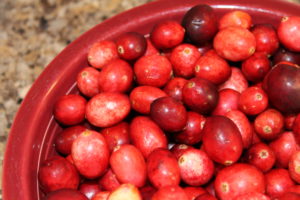
Only about 5% of cranberries are sold fresh; most are made into juice and sauce.
Only about 5% of cranberries are sold fresh in the produce aisle during the holiday season. Another small percentage is sweetened, dried, and marketed as a raisin-like dried fruit. About 90-95% of cranberries end up in a juice or sauce product.
Cranberries are unique among fruits in that they can be refrigerated without losing quality for several months, or even longer if frozen. So processing cranberries into juice, sauce, and dried products can be spread out over the year, whether you are a major company, or just someone that loves cranberries.
I always thought of the East Coast of the U.S. as “the” major cranberry producer. I was surprised to learn Wisconsin produces about half of the national cranberry crop, and Massachusetts is runner-up with about one-third of the crop. Oregon, Washington, and New Jersey round out the top cranberry producing states.
Growing Cranberries at Home?
I’ve seen cranberries advertised in catalogs and sold at local garden centers in recent years. Does this mean you can put homegrown cranberry sauce on your holiday table?
In theory, at least, you should be able to grow cranberries in central Illinois. The climate isn’t a problem, but most soils in Illinois are not nearly acidic or sandy enough for growing cranberries.
The recommended pH for growing cranberries is 4.0 to 5.0. Our Midwestern soils are naturally slightly acidic to neutral (pH 6.5-7.0) but may edge over into alkaline (pH > 7.0) in clay soils.
Our soil has a lot of natural buffering capacity. In other words, the pH tends to stay where it is due to the minerals present. Changing the pH requires saturating this system—which is a fancy way of saying it takes a lot of effort and work.
In our garden, we tried to grow blueberries, another fruit that prefers acid soil. Despite amending the soil for years on end, we never had more than a handful of berries.
The plants always looked somewhat yellow and sick, a sure sign that they were not growing under the proper pH conditions. I’m sure if we’d have made amending the soil a higher priority we might have had more success. But we decided growing blueberries was just not a good use of our limited time.
If the thought of years of constant soil amending doesn’t deter you, there’s a good chance you could grow some cranberries of your own in central Illinois. Fortunately, cranberry plants don’t have to spend the winter underwater—a good layer of mulch or floating row cover will combat the drying winter winds.
If you’d rather leave cranberry growing to the experts, at least consider making fresh cranberry sauce for the Holidays this year.
- Combine one cup of sugar with one cup of water and bring to a boil. Add 12 ounces (usually one package) of fresh cranberries. Bring to a boil and reduce heat to a simmer. Stir constantly.
- Berries will begin to pop as the air pockets within the cranberries expand with heating. After about 10 to 15 minutes of simmering, berries should be thoroughly cooked. Pour freshly cooked sauce into a decorative mold or container and cool before serving.
- A tasty variation: add 1/4 cup orange juice to sugar/water mixture at the start of cooking or mix in a shot of Grand Marnier liquor to cooling cranberry sauce to add a hint of orange to the finished sauce.
If you liked this post, please subscribe to Grounded and Growing today and receive your copy of “15 Tips to Become a '15 Minute Gardener'” so you can spend less time working ON your garden and more time enjoying being IN your garden.! It’s absolutely free. When you join the Grounded and Growing community, you’ll finally take the garden off your “To-Do” list and allow yourself time to enjoy your garden and savor the peace and serenity there. I tell subscribers about new posts as soon as I hit ‘publish’ and send weekly-ish updates on what’s going on in my garden– good, bad AND ugly.
All Rights Reserved. © 2017 Jennifer Schultz Nelson



Your blog entries always teach me so much. Thanks for sharing all this information about cranberries!
My mom always ground cranberries, apples, and oranges together and then added sugar. We ate this cranberry salad raw. After I married, I watched a cousin make a cooked cranberry sauce, much as in your recipe, but she added peeled, diced apples and the diced flesh of an orange and some orange zest. I loved this method of making cranberries and have made it this way for about 50 years. My family has never eaten it with me, so I freeze the cooked fruit in cup portions; I always try to freeze enough to last me all year. It is yummy with baked poultry or beef roast!
Hi Ruth Ann, thanks so much for reading and commenting! Your cranberry recipe sounds delicious! I will have to try it. I’m glad you’re enjoying the blog!
A raised planter bed might be a good way to grow a few plants. If you filled it with a peat-based potting soil, completely replacing native soil, you could have a little island of cranberries. It would be expensive and a lot of work, but if you really wanted home-grown cranberries, you could do it!
That’s a great point Margaret! I bet it would work! I’ve grown blueberries in containers to avoid the nightmare of trying to acidify our soils and it’s worked well, why not try it with cranberries?
I have a lazy way to cook cranberries; I just add a cup of sugar to fresh cranberries and let them simmer or very softly boil for 20 minutes or so. I stir frequently but not constantly. Anyway, it makes a tangy sauce but there in no gel. Guess I’ll try adding water this year!
Sounds good to me Beth! One of the glorious things about cooking, especially at holiday times is how many recipes there are for essentially the same dish. I love hearing everyone’s favorites!