I spent 12 years working as an Extension Educator, extolling the virtues of garden planning. Any lecture on any gardening topic pretty much started with some form of step 1: Make a plan.
Little did most people know, I’ve hardly ever made a formal garden plan.
Turns out the reality is I am a terrible garden planner, at least in a traditional sense. The only graph paper I own is a partially used pad from college.
So if you feel like you’re less of a gardener because making a scale drawing of your garden is not your idea of a good time, rest assured you’re not alone.
But don’t get me wrong. I plan. Obsessively sometimes. But I have a hard time putting my ideas on paper.
This tendency was the source of some huge arguments between me and my husband when we moved into our new house twelve years ago, complete with absolutely no landscaping. Give him a box of colored pencils and graph paper and he will lay out the garden of your dreams in an afternoon; I will have some beautiful ideas in mind too, but I’m much more content to allow inspiration at the garden center to bring those ideas to life. “Why can’t you just make a plan and stick to it?” my husband would argue with me, “Why is this so hard?”
I don’t know. It probably has something to do with the fact that I may have one plant in mind, but then I go to the garden center and find a dozen more that I hadn’t thought of that might work better. And of course there’s always the plants that are too beautiful to pass up, that you know you have room for somewhere…
As we bickered and planted gardens at our house, I started thinking maybe I was a fraud. Here I am teaching people the importance of planning out their garden, but I’m not doing it myself. Then the topic came up among a group of colleagues at a work gathering. I was so relieved to hear person after person admit to standing in their yard with a plant in one hand and shovel in the other, looking for the perfect spot. It wasn’t just me!
I used this revelation as proof to my husband that my lack of a paper plan was perfectly fine; I proceeded to plant. And plant. And plant.
But then the plants grew. And grew. And grew.
A good chunk of my garden beds needed very regular attention in order to not look like wild mess. Once my son entered the world, those regularly occurring gardening sessions went out the window. I was lucky to get a few minutes here and there and the luxury of an hour or two if naptime was successful.
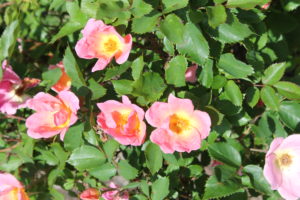
Knock-out rose ‘Rainbow’ in front of our house.
I noticed something interesting around this time. Back when we were planting new garden beds around our house, as a compromise during one of our bickering sessions I drew up a plan, on actual paper, for the bed in front of our house. I even measured out the space with a tape measure. Surprisingly, that bed looked relatively decent despite spotty post-motherhood care.
That was when I knew I needed a plan for my other gardens. Despite the fact that I will never ever be excited about graph paper.
Did I buckle down with a tape measure and graph paper and map out my gardens? Uh…. no. It’s just not me. I did make a few lists of what I had, what still looked good. I relocated a few plants. And *gasp* I even tilled under one section of garden after I decided it just so overgrown and out-of-hand I just needed to start over.
What am I doing differently moving forward?
- Using a tape measure in more than just the vegetable garden– as much as I resisted using a tape measure in our ornamental beds, I had always used one in the vegetable garden. No doubt this is a remnant of working in cornfields a good chunk of college and all of grad school. I am a terrible estimator of space; I always think I have more space than there is. But if I have the dimensions of an area, that does keep me from having eyes bigger than my garden while shopping.
- Paying closer attention to mature sizes of plants, and allowing space for that size when planting– Plants given room to grow to their mature size without crowding are healthier and don’t need as much fussy maintenance like constant pruning to fit limited space. I firmly believe this is the one big reason my plantings in front of our house looked halfway decent despite near total neglect when we were new parents.
- One of the big mistakes I made when I started our gardens was I planted WAY too many plants. The “blank canvas” of an empty yard that everyone said they envied was a huge source of anxiety and overwhelm to me. It was all too easy to fill the empty space, but plants have a way of doing this thing called growing….
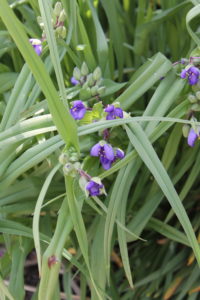
Spiderwort (Tradescantia sp.) that appeared in with some hostas. I suspect it is a seedling from the cultivar ‘Sweet Kate’ that I have elsewhere in the garden. This seedling did not retain the lime-green leaves that attracted me to ‘Sweet Kate’ but the bluish flowers will work well in my Illini garden (orange and blue).
- I’m trying to use what I already have before buying more plants. Before I head to the garden center, I’m looking at my garden beds to see if there are any crowded plants that would work elsewhere in our landscape.
- I thought I could take pictures of my garden beds along to the garden center so I’d be more realistic about how many plants I needed. That backfired on me. I am a very visual person, but the pictures I had snapped right before going shopping didn’t tell the whole story. I got to the garden center and was overwhelmed with the selection and unsure about which plants had survived winter and which had not back home. After doing some spring clean up, I have a much better handle on what each bed needs (plus an actual list!)
- I am way more reluctant to accept plants from friends and neighbors, and I am super picky on what I consider at community plant sales where folks sell divisions from their own gardens. Some of my most invasive, awful, pain-in-the-rear plants came from well meaning people wanting to share their plants. Keep this in mind as you shop these sales for your own garden. If there is an entire eight foot table filled with the same plant, keep walking. There is a reason there are so many orange daylilies and purple iris for sale; they grow like mad! You may have a spot where you need these vigorous growers, but take heed if you don’t!
I’ll never ever be a gardener that plans every square inch of the garden out on paper. But rather than shame myself for it like I’ve done in the past, I’m working on accepting what works for me. I’m not the fraud I thought I was. I do plan my garden– in my own way. I’ve made plenty of mistakes in my garden, but I’m recognizing them and correcting them. I’ve been decluttering and simplifying the inside of my house, and in a lot of ways I’m doing the same thing outside in my garden this growing season.
Someone commented to me after we were in our house a year or two, “Oh so you’re landscaping must be finished by now.” They looked at me funny when I responded “a garden is never finished.” A gardener is always experimenting, always finding new plants, new ideas to try. We all evolve as gardeners, learning new lessons with every passing year. What kind of plans do you have for your garden this year?
If you liked this post, please subscribe to Grounded and Growing today and receive your copy of “15 Tips to Become a '15 Minute Gardener'” so you can spend less time working ON your garden and more time enjoying being IN your garden.! It’s absolutely free. When you join the Grounded and Growing community, you’ll finally take the garden off your “To-Do” list and allow yourself time to enjoy your garden and savor the peace and serenity there. I tell subscribers about new posts as soon as I hit ‘publish’ and send weekly-ish updates on what’s going on in my garden– good, bad AND ugly.



Love your comments !! ?❣️
Great article Jennifer! We are going to rip out some non-native grasses this week and plant 3 Ninebarks. They can grow to 10 feet wide. I so want to plant them closer (like 8 to 9 feet apart) but this probably isn’t a good idea after reading your pearls of wisdom. What’s your experience with Ninebark?
Hi Melissa, thanks for commenting! I haven’t grown ninebark myself, but what I have read is they can be susceptible to powdery mildew, a fungal disease. Powdery mildew usually doesn’t kill a plant, but it just looks terrible for the rest of the season. A great way to prevent problems with fungal diseases of any sort without spraying fungicides is to allow for good air circulation around the plant and through the foliage. So I would suggest keeping your new plantings spaced at least 10 feet apart if they are expected to get to 10 feet wide when mature just to allow for that air circulation. Even if the spacing doesn’t prevent the powdery mildew, it should lessen the severity. But you may not have issues with it at all.